Masthead_Gloucester_Kearn.jpg
Posts in Manhattan
The “Tavern on the Green”: How a Central Park Landmark Epitomizes Colonial New York City’s Urban Development

The “Tavern on the Green”: How a Central Park Landmark Epitomizes Colonial New York City’s Urban Development

By Vaughn Scribner

The Tavern on the Green restaurant is an icon of New York City. Nestled in the seemingly-rustic, yet carefully-planned confines of Central Park, the building began life in 1870 as a shelter for the park’s grazing sheep.[1] In 1934, park officials transformed the building into a restaurant. Since then, various families bought into the business, and made renovations like a dance floor, glass-enclosed Crystal Room, and a new patio.[2] Beyond offering a diverse array of cocktails, main courses, and appetizers, however, much of the restaurant’s enduring popularity owes itself to setting: the Tavern on the Green is a carefully-crafted combination of urban and rural life; a “hybrid” space where customers feel like they’re escaping the gray, crowded confines of the city, but still have access to the entertainment and sociability for which New York City is famed.[3] But the Tavern on the Green does not just represent fantasy, or a New York that “never was.” On the contrary, the Tavern on the Green harkens back to the second half of the eighteenth-century, when New York City’s residents fostered an urban culture predicated upon a thriving network of taverns and green spaces which offered residents the hospitalities of city life within a bucolic, relaxing, and intentionally-constructed “natural” environment.

Read More
The Carleton Commission and Evidence of Arson in the Great New York Fire of 1776

The Carleton Commission and Evidence of Arson in the Great New York Fire of 1776

By Bruce Twickler

In October of 1783, just six weeks before the British evacuated New York, the Commander-in Chief-of the British forces, Sir Guy Carleton, commissioned a panel of three British officers to investigate the disastrous fire that devastated the city seven years earlier. Shortly after midnight on September 21, 1776, fire had erupted in lower Manhattan. By daybreak it had consumed five hundred buildings – including schools, churches, warehouses and homes – and caused more destruction than all the previous colonial fires in New York combined.

Read More
How Prohibition Killed the Bowery

How Prohibition Killed the Bowery

By Alice Sparberg Alexiou

Back in the days when the Bowery epitomized New York at its grittiest, most honkey-tonk, warm-hearted best—between the end of the Civil War and World War I—nothing was more important to the well being of the street’s motley population of artists, actors, immigrant poor, and bums than the saloon. Yes, the saloon. It was a Bowery institution. During the Bowery’s peak years, the 1890s, the street boasted nearly 100 saloons, each with its own clientele and reasons for existing. In the days of Tammany, specific saloons functioned as political clubhouses; there were “concert saloons,” where the races mingled and drank and sang and had a grand old time, singing and dancing to songs with dirty lyrics banged out on rinky-dink pianos, and waitresses doubled as prostitutes. In some saloons, homesick German and Irish immigrants found compatriots with whom to drink away their pain. And other saloons were like drunken old grandmothers who gathered all those Bowery bums into their beery bosoms and comforted them, providing shelter and the chance to convene with other bummy alcoholics, all of whom had run away to the Bowery from all over the country and the world with a specific purpose: to drink among others who were just like them.

Read More
How The Volstead Act Ruined New York’s French Pleasure Palaces

How The Volstead Act Ruined New York’s French Pleasure Palaces

By Alice Sparberg Alexiou

At the beginning of the twentieth century, when New York was rolling in dough but had a dearth of rarified places in which to spend it, enterprising immigrants who knew how to run restaurants began coming to New York. They knew because they’d grown up in France or Switzerland, in bistro-owning families. In New York, after working their asses off at one of the few already-existing luxury restaurants--Delmonico’s was the most famous—the newcomers then combined what they’d just learned about how to run a New York restaurant with their Gallic sensibilities around food, ambiance, and, most of all, drink—what French chef, after all, creates cuisine without the addition of alcohol, be it wine or brandy, and enlarged them to fit New York’s eye-popping scale. They opened big restaurants, then the trend in New York—“lobster palaces.” But these were different, because they were French, where New Yorkers were introduced to the joys of pate de foie gras and frogs legs, were taught them what wines to drink with these exotic dishes. And so was created a unique and scintillating French dining scene in New York , a product of a specific time in New York history, that is now largely forgotten.

Read More
DyckmanDISCOVERED: Fostering Inclusive Historical Narratives

DyckmanDISCOVERED: Fostering Inclusive Historical Narratives

By Meredith Sorin Horsford

In 2015, the Dyckman Farmhouse Museum (DFM), which had been a very traditional historic site with little relationship to its community, came under new leadership. Soon after, DFM became the recipient of a grant program called shatterCABINET with the Chipstone Foundation, which provides funding to rethink how historic house museums can be relevant to their present-day community. Through this grant, the Dyckman Farmhouse removed all of the room barriers that had previously prevented visitors from entering the period rooms, installed bilingual labels and signage, and began offering bilingual programs, promotional materials, and visitor services. This not only impacted the audience that we serve, as neighborhood residents began visiting the museum for the first time, but it also helped the organization reshape public programs to feature interpretation that connects the history of the site and its rural roots to the present-day urban community.

Read More
Racial Migrations: New York City and the Revolutionary Politics of the Spanish Caribbean

Racial Migrations: New York City and the Revolutionary Politics of the Spanish Caribbean

Jesse Hoffnung-Garskof, interviewed by Tyesha Maddox

In the late nineteenth century, a small group of Cubans and Puerto Ricans of African descent settled in the segregated tenements of New York City. Jesse Hoffnung-Garskof’s book presents a vivid portrait of these largely forgotten revolutionaries and reveals the complexities of race-making within migrant communities and the power of small groups of immigrants to transform their home societies.

Read More
Tudor City: Manhattan’s Historic Residential Enclave

Tudor City: Manhattan’s Historic Residential Enclave

By Lawrence R. Samuel

Walk east a few blocks from Grand Central Station along 42nd Street, take the stairs near the Church of the Covenant and voila!—you’ve entered another world. Tudor City—the five-acre faux medieval village, albeit with high-rise apartment buildings—is on the far east side of midtown Manhattan between First and Second Avenues and 40th and 43rd Streets, right around the corner from the United Nations. Tudor City is not just the architectural masterpiece created by real estate developer Fred F. French and the first residential skyscraper complex in the world; it’s a unique community that has played a significant role in the history of New York City over nearly the past century. The story of the “city within a city,” as it quickly became known, tells us much about life in Manhattan since the late 1920s, when the development came into being.

Read More
“HORRID BARBARITY:” A Trial Against Slaveholders in New York City

“HORRID BARBARITY:” A Trial Against Slaveholders in New York City

By Kelly A. Ryan

In February 1809, three seamstresses made their way to the special justices of New York City to register a complaint against their employers for abusing the slaves living in their household. They charged Amos and Demiss Broad, a married couple who ran an upholstery and millinery business in the second ward of New York City, with a litany of abuses, including throwing a knife at a three-year-old child. An unlikely trial occurred at the Court of General Sessions by the end of the month, in which the Broads stood trial for assaulting Betty and her three-year-old daughter Sarah. Ultimately, nine witnesses came forward against the Broads, and two of the witnesses who originally agreed to provide evidence for the Broads ended up supporting the prosecution. Though the employees and neighbors of the Broads would be critical to pushing this case forward, Betty’s efforts to get help forced New York City to reckon with the cruelty of slaveholding. The case against the Broads would be a stunning victory for African Americans and the New York Society for the Manumission of Slaves (NYMS), as well as an important moment in generating discussions about the rights of slaves to live unmolested.

Read More
The Rebel Cafe: Sex, Race and Politics in Cold War America's Nightclub Underground

The Rebel Cafe: Sex, Race and Politics in Cold War America's Nightclub Underground

Reviewed by Burton W. Peretti

Stephen R. Duncan’s new book admirably fills a void in the historiography of 20th century American culture. We long have recognized that between the storied nightclub era of Prohibition days and the age of rock ’n’ roll, there was a perceptible but elusive set of nightlife entertainment venues that kept radical left-wing political values percolating during the Depression, World War II, and the Cold War. Historians have explored chapters in New York City’s interregnum — David Stowe, for example, covers Cafe Society in the late 1930s, Patrick Burke describes the jazz clubs on 52nd Street, and James Gavin chronicles European-style cabaret — but a comprehensive history, with more of a national perspective, has been lacking. Duncan’s ambitious and wide-ranging work makes a terrific new contribution toward defining the paramount significance of radical and intimate performance venues of the 1940s, 1950s, and early 1960s.

Read More
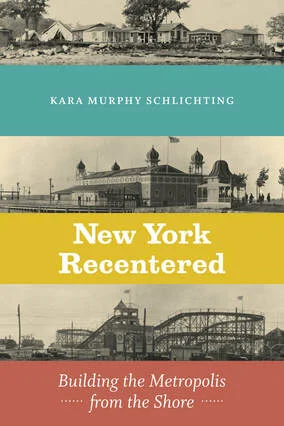
New York Recentered: Building the Metropolis from the Shore

New York Recentered: Building the Metropolis from the Shore

By Kara Murphy Schlichting

In 1865 New York City park commissioner Andrew Haswell Green came to the conclusion that the city had outgrown Manhattan Island. In a report for the Board of Commissioners of Central Park, Green argued that the city’s future should include its mainland environs of Westchester County north of the Harlem River. He articulated a river-spanning future for New York. Green reasoned that lower Westchester was “so intimately connected with and dependent upon the City of New York, that unity of plan for improvements on both sides” of the Harlem was “essential.”

Reprinted with permission from New York Recentered: Building the Metropolis from the Shore, by Kara Murphy Schlichting, published by the University of Chicago Press. © 2019 by the University of Chicago Press. All rights reserved.

Read More