Masthead_Gloucester_Kearn.jpg
Posts in Manhattan
Myth #8: Static Manhattan, Part II

Myth #8: Static Manhattan, Part II

By Gerard Koeppel and Jason M. Barr

Today, the image of Manhattan is as a vertical city — a place that, as E. B. White saw it, “has been compelled to expand skyward because of the absence of any other direction in which to grow.” With our eyes focused skyward, we think little of the city’s horizontal expansion, as the grid plan seemingly set Manhattan in stone, literally and figuratively.

This is the final installment of the authors' series The Manhattan Street Grid: Misconceptions and Corrections.

Read More
Myth # 7: Static Manhattan, Part I

Myth # 7: Static Manhattan, Part I

By Jason M. Barr and Gerard Koeppel

Today, Manhattan is synonymous with its Cartesian configuration. Unlike a standard mathematical graph, which starts at the intersection of zero and zero, Manhattan “begins” at First Street and First Avenue (the “nexus of the universe,” according to Seinfeld’s Kramer). From there, it’s a simple counting exercise north or west. The integer-based order creates the perception that Manhattan is a frozen lattice.

But, when one starts to look a bit deeper, we can see that the grid plan has, in fact, shown significant evolution, both in the early phases of its implementation and throughout the 20th century. Though the pace of change is slow, a “helicopter tour” through time reveals these cumulative modifications.

Read More
Myth #3: Aaron Burr

Myth #3: Aaron Burr

By Gerard Koeppel with Jason M. Barr

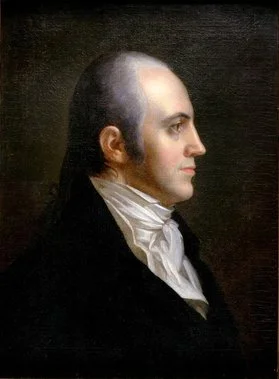
It could be said that Aaron Burr, the baddest boy of early American democracy, is responsible for the famous Manhattan street grid. In a backhanded way — a way he surely would appreciate — he is.
But, like a perverse Madame de Pompadour, the deluge of orderly streets came after him, entirely without his input while he was laying low in Europe.

Read More
Myth #2: The Commissioners as Visionaries

​Myth #2: The Commissioners as Visionaries

By Gerard Koeppel with Jason M. Barr

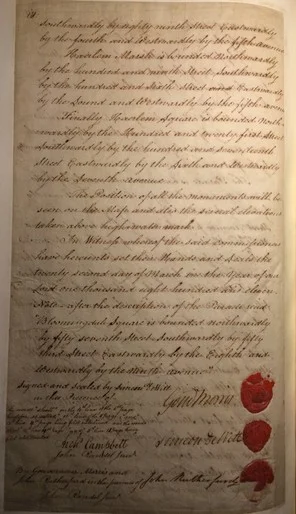
Aside from their map, the only record the commissioners left for posterity was an eleven-page document outlining the basics of the plan that gridded Manhattan from North (now Houston) to 155th Streets. The document, dubbed “Explanatory Remarks,” explains little of the commissioners’ thinking. Their personal writings practically ignore their work. Over the generations, great intent has been ascribed to the commissioners for which there is no evidence. Analysis of the commissioners’ actions shows that the grid plan was not a “plan” so much as a convenience to satisfy a deadline. That is, not a plan but rather a “rush job” because the commissioners demonstrated little interest in their responsibilities until the final months of their four-year term. Manhattan’s future was sealed with scarcely a discussion.

Read More